
Sex Offender Checks in Kenosha County
The Wisconsin Sex Offender Registry Program is the primary public channel for a Kenosha County search. Wisconsin DOC manages the Kenosha County entries under state registration and notification laws. Search by name when the person is known. Use the location controls when the Kenosha question concerns a street, ZIP code, city, or the county as a whole. The Kenosha County registry result is distinct from a Kenosha County court case, jail booking, or DOC supervision record.
Gather the most precise Kenosha facts that can be used lawfully before searching. Exact spelling helps. A Kenosha city or ZIP filter can narrow a common name. Compare aliases, physical descriptors, conviction jurisdiction, and the Kenosha profile's public status fields before deciding that a result concerns the right person. Kenosha County registry data can change as DOC receives updates, so note the information date and return to the official Kenosha profile for a later check.
Kenosha Registry Name or Place
Name and location searches answer different Kenosha County safety questions. A Kenosha name search works best when identity is already known. A Kenosha location search supports neighborhood awareness without guessing who may live nearby. The live portal controls which Kenosha street, city, ZIP, county, and radius options are available. The exact Kenosha radius choices were not captured in the research, so readers should use only the options that the official form displays.
Neither Kenosha method proves a person's present location at each moment. Public Kenosha residence information is governed by Wisconsin law and DOC policy, and not every Kenosha profile has identical detail. If a Kenosha name match looks uncertain, compare several public fields. Do not treat a shared name as identity or infer that a person is out of compliance merely because an expected item is not visible.
How to Search the Wisconsin Sex Offender Registry Program
The Kenosha County registry process begins with the state portal rather than a separate Kenosha database. The public warning and terms set the safety purpose for Kenosha data. A careful Kenosha search uses a short sequence and preserves enough context to verify the result later.
- Open the Wisconsin registry and accept its current warning and conditions.
- Choose the name path or the location path, then enter the most exact facts known.
- Review possible matches and compare public identifiers instead of relying on the name alone.
- Open the profile, read the offense and registration fields, and note when the information was updated.
- Use the national search when the Kenosha County location question reaches Illinois or another state.
| Field label | Type | Search path | Use |
|---|---|---|---|
| Last and first name | Text | Name | Spelling matters; use both when known |
| Address | Text | Location | Use the live street controls |
| City, ZIP, or county | Location filters | Location | Select Kenosha County or a local municipality when offered |
| Search radius | Dropdown | Location | Use current portal choices; do not assume a distance |
The official registry screen itself could not be captured successfully. The search fields above come from the research inventory, not from a third-party listing.
Kenosha County Registry Border Search
Kenosha County borders Illinois, so a Wisconsin-only location search may stop before the practical area of concern does. The National Sex Offender Public Website federates participating state and territorial registry data. It supports name fields and an address or radius route, subject to the data each jurisdiction provides. Use it as the cross-state layer, then return to the source registry named in a result for the controlling profile.
The official NSOPW interface illustrates that national reach:
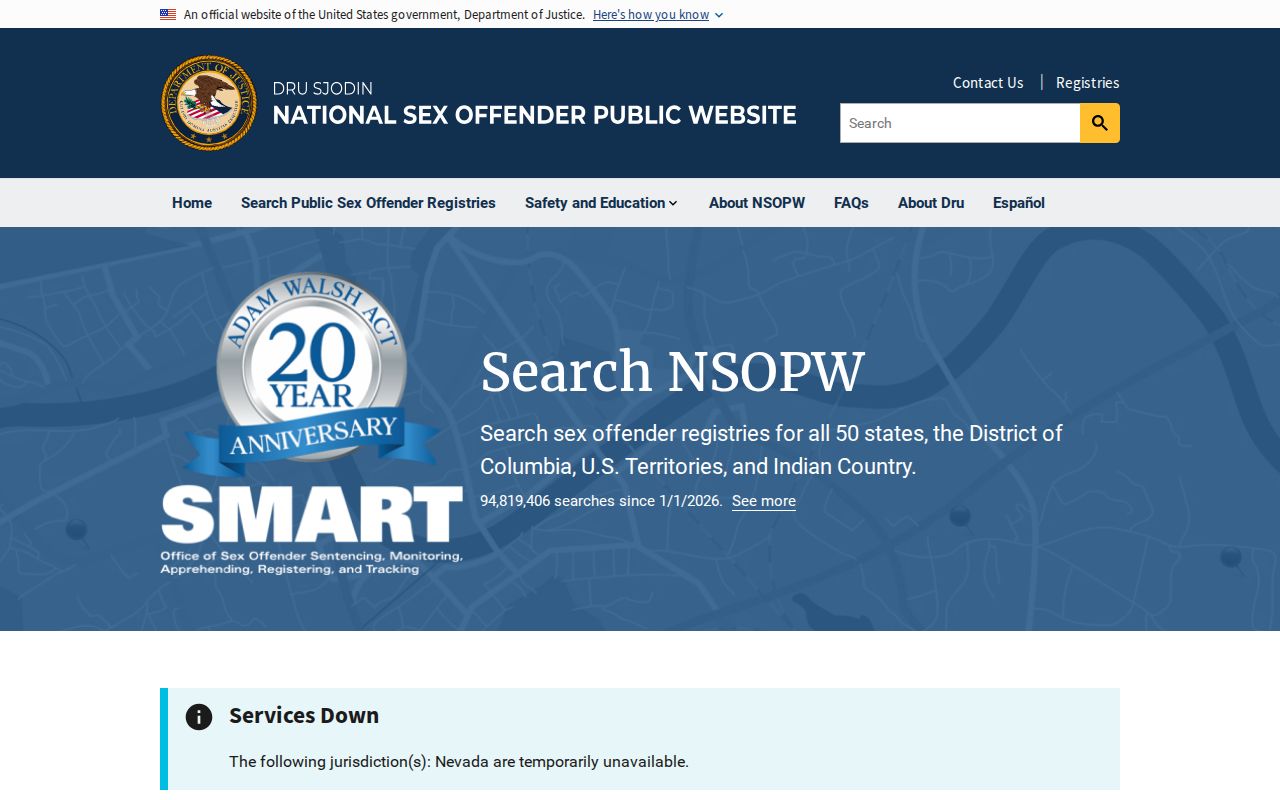
For a Kenosha County address near the state line, this second Kenosha pass helps avoid an artificial boundary while keeping the search within official government channels.
Kenosha state and national results may not display fields in the same way. A missing Kenosha detail in one view is not proof that it does not exist. Check the source registry, its disclosure rules, and the update date before relying on a Kenosha cross-border match.
Inside a Registry Profile
A Wisconsin public registry profile brings together Kenosha identity, offense, and registration information that DOC may disclose. It is not a full Kenosha criminal history. A Kenosha court file can contain pleas, motions, and later case events that do not fit the registry profile. Kenosha County readers should treat each Kenosha field as one part of the identification and notification record.
| Name and aliases | Published names used to distinguish the registrant. |
|---|---|
| Photo and description | A public image, physical descriptors, and identifying marks when published. |
| Residence information | Location detail allowed under Wisconsin law and DOC policy. |
| Offense record | Conviction jurisdiction, offense description, statute, and date when shown. |
| Registration data | Registration or compliance status and the responsible region when public. |
| What is not measured | The profile does not supply a real-time guarantee of location or a complete measure of current risk. |
Kenosha profiles do not all expose identical detail. Wisconsin's public-notification law controls what Kenosha information is released, and special rules may apply to juvenile or minor-related registration.
Kenosha County Registry Law Explained
Two linked statutes do different work for Kenosha County. Wis. Stat. § 301.45 sets the Kenosha registration framework. Wis. Stat. § 301.46 governs Kenosha public access and community notification. Keeping those roles separate helps explain why a Kenosha duty to register does not automatically produce the same public detail for every person.
The official public-access law is shown in the manifest image below:
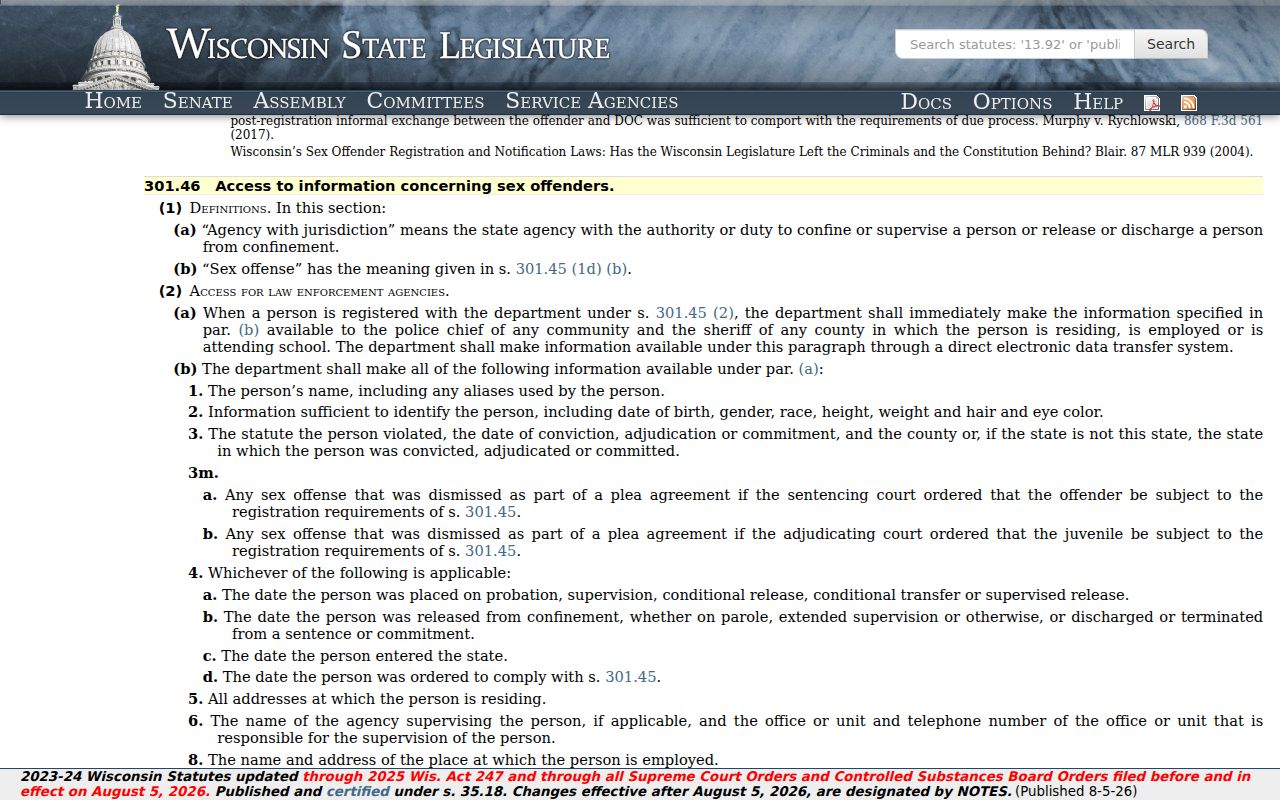
For Kenosha County, the Kenosha public profile is the result of both the registration duty and the separate disclosure rules. Kenosha readers should not substitute a generic federal tier chart for Wisconsin's system.
The registration statute provides the matching legal foundation:
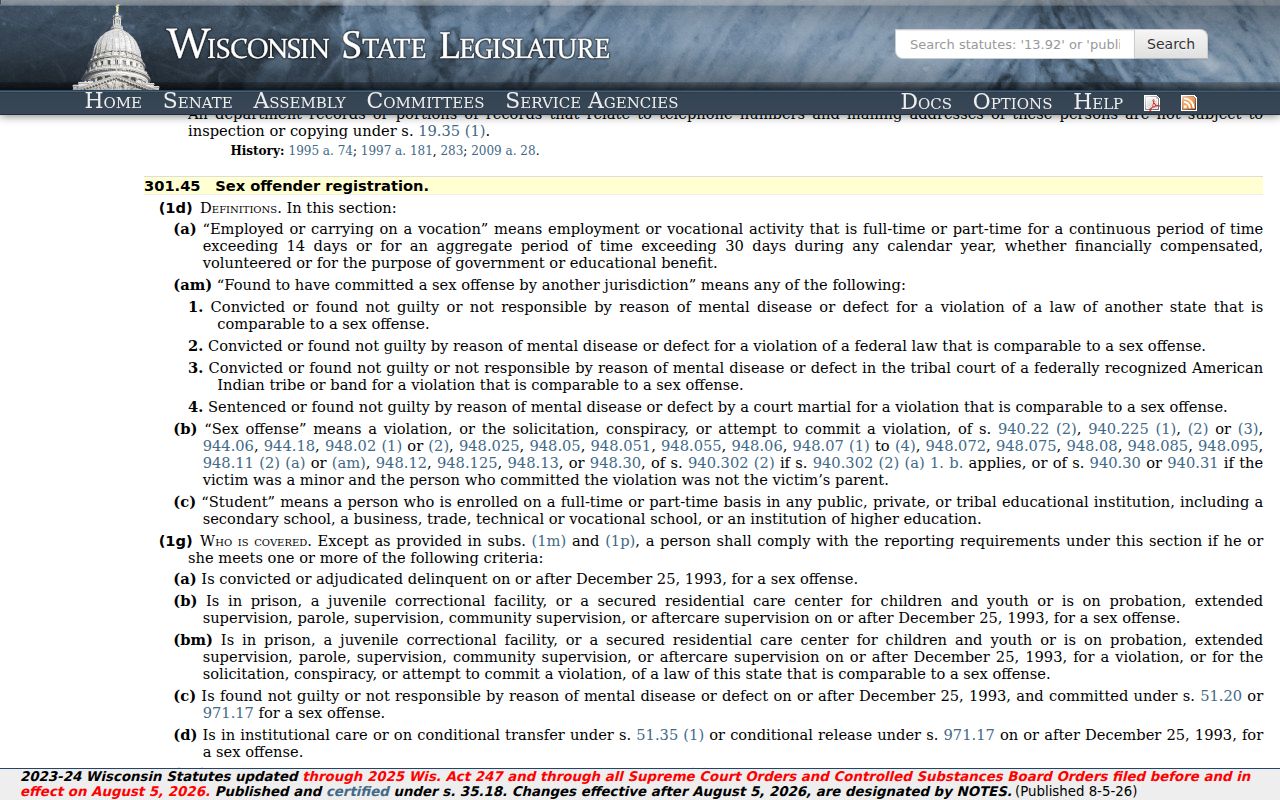
Together, the statutes explain why Kenosha duration, public visibility, and notification can vary with the offense, case circumstances, court orders, and DOC rules.
Wisconsin Registration Levels and Requirements
Wisconsin does not fit a simple public Tier I, Tier II, and Tier III chart. The duty and duration depend on the statute that applies to the conviction or order. Public notification is a related but separate decision. This table reflects the categories documented for Kenosha County searches without assigning a made-up risk tier or verification schedule.
| Wisconsin category | Duration or effect | Public visibility |
|---|---|---|
| Covered conviction or order | Statutory period for the case, often 15 years after the qualifying release or supervision endpoint | Controlled by § 301.46 and DOC rules |
| Lifetime category | Life when the precise offense or circumstance provision applies | Disclosure detail can vary |
| Public notification | Separate from the length of registration | DOC and local law-enforcement rules govern |
| Juvenile or minor-related case | Special statutes and orders apply | Must not be generalized from adult categories |
Kenosha registration can also continue after community supervision ends. Wisconsin's 2025 DCC report counted 27,404 registrants statewide as of July 1, 2025. Of those, 14,903 were no longer on supervision but still registering. A Kenosha registry status therefore does not mean that a person is now on probation, parole, or extended supervision.
Kenosha Registry Status and Supervision
The Wisconsin DOC person and client systems serve different Kenosha questions. A Kenosha registry profile concerns registration and public notification. Community-corrections records concern probation, parole, or extended supervision. Custody records concern prison status. A Kenosha County registrant may be incarcerated, under active supervision, or no longer supervised while a registration duty remains.
Eligible victims can use DOC NOTIS for notices about custody, supervision, and registry status. The official notification service is pictured here:
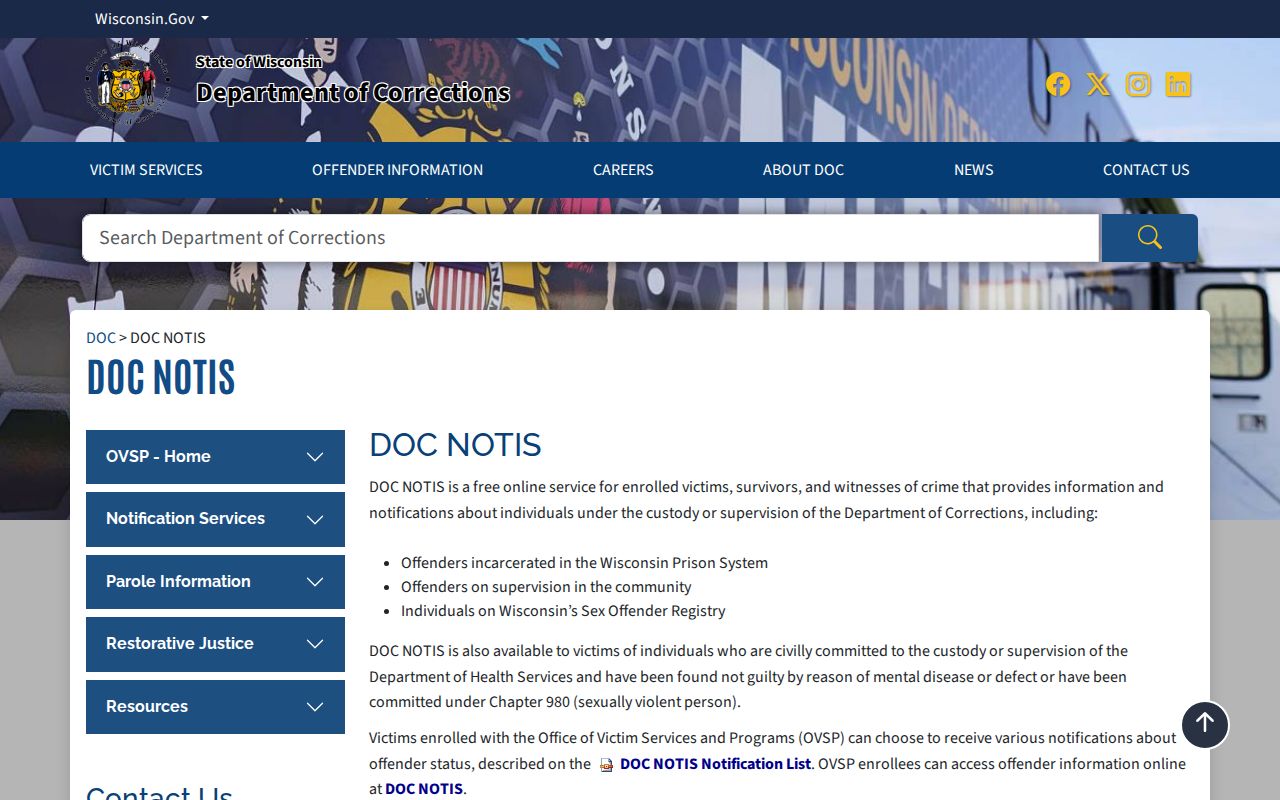
NOTIS is a notice channel, not a replacement for a fresh Kenosha County registry search. Check the public profile for current public registry fields and use the notice service only within its eligibility and enrollment rules.
When Kenosha Registry Data Looks Stale
Do not confront a registrant when a Kenosha profile appears old, a location seems wrong, or a compliance concern arises. First, check the information date and repeat the official Kenosha search with exact details. Confirm that the result concerns the correct person. If the Kenosha concern remains, report it through law enforcement or the Wisconsin DOC Safe Tip Line at 1-877-234-0085.
Registrants who need to update their own information should follow DOC instructions and call the state registry number at 608-240-5830. A separate Kenosha County walk-in registration address, hours, and fee were not verified in the official sources. The Kenosha County Sheriff's Office can route a local question at 262-605-5100, but callers should not assume that an unverified walk-in process exists.
When a county contact path changes, start with the official Kenosha County directory. Its justice-office telephone listing helps confirm the current local number without relying on a private directory.
Note: A suspected error or lapse calls for official verification, not an online accusation or private investigation.
Community Notification and Lawful Use
Registry access supports personal, family, and community safety. Use the Kenosha County results to understand the public information DOC has released, plan sensible precautions, and contact the right public office when facts need review. A listed offense does not measure present risk by itself. The profile also cannot guarantee a person's location in real time.
Wisconsin's registration and notification statutes do not authorize private punishment. Preserve the exact source and date if information must be reported. Give a public agency the facts and let it verify identity, status, and compliance.
Use registry data lawfully: Wis. Stat. § 301.46 governs public notification. Harassment, threats, intimidation, or vigilante action can be criminal and defeat the registry's public-safety purpose.